
Trauma Therapy in Culver City, CA
If you've been carrying the weight of the past longer than you can remember, you know what I'm talking about. The hypervigilance. The emotional flashbacks. The relationships that feel just out of reach. Trauma therapy is a structured, evidence-based path toward lasting relief. At Restorative Counseling Center, I offer specialized trauma therapy for women in Culver City and throughout California and Florida, using Polyvagal-enhanced EMDR to address the experiences that have shaped how you feel, think, and connect, at a neurological level.
What Is Trauma Therapy, and Who Is It For?
Trauma therapy is a specialized form of psychotherapy designed to help you process and integrate painful or overwhelming experiences so that they no longer drive your reactions, your relationships, or your sense of self. It is not simply talking about what happened. Effective trauma therapy works with the nervous system, the body, and the mind together, because trauma is stored across all three.You may benefit from trauma therapy if you:Experience intrusive memories, nightmares, or flashbacks.Feel chronically hypervigilant, anxious, or emotionally "on edge."Struggle with numbness, disconnection, or a sense that life feels flat.Carry shame, self-blame, or deeply held beliefs that you are not enough.Find it difficult to trust others or to feel safe in relationships.Have experienced childhood trauma, adverse experiences, grief, loss, medical illness, or assault.Are navigating trauma that others may not recognize as trauma. Chronic emotional neglect, invalidating family dynamics, or experiences that left you questioning your own reality.
Trauma does not require a dramatic single event. Many of the women I work with at Restorative Counseling Center carry what is often called "small t" trauma. It is the accumulated weight of being unseen, dismissed, criticized, or unsupported in ways that shaped the nervous system just as powerfully as more recognized traumatic events. You may not even think of what happened to you as trauma, but you can't shake the feeling that something is broken inside you, that something is inherently wrong with you. That feeling is not the truth about who you are. It is what trauma does.Polyvagal-Enhanced EMDR: A More Complete Approach to Trauma
EMDR (Eye Movement Desensitization and Reprocessing) is one of the most extensively researched trauma treatments available. It is endorsed by the American Psychological Association, the World Health Organization, and the U.S. Department of Veterans Affairs as an evidence-based treatment for PTSD and trauma-related conditions.In an EMDR session, you briefly hold a distressing memory in mind while engaging in bilateral stimulation, most commonly guided eye movements or tapping. This bilateral activation appears to allow the brain to process the stored traumatic memory in a way that talking alone does not. Over time, the memory loses its emotional charge. It becomes a part of your history rather than something your nervous system is still actively defending against.What EMDR therapy commonly achieves:Reduced emotional intensity around specific memories and triggers.Shifts in core negative beliefs, moving from "I am not safe" or "I am not enough" to beliefs that reflect your actual present-day reality.Improved nervous system regulation, greater capacity to stay present rather than defaulting to fight, flight, or freeze.Stronger relational capacity, the ability to tolerate closeness, set boundaries, and experience connection without bracing for harm.

Standard EMDR is effective. Polyvagal-enhanced EMDR is more precise.
Polyvagal Theory, developed by Dr. Stephen Porges, maps the autonomic nervous system's three primary states: the ventral vagal state (safety and connection), the sympathetic state (mobilization, fight or flight), and the dorsal vagal state (freeze and shutdown). Trauma dysregulates this system. Without addressing the nervous system's baseline state, traditional EMDR processing can move faster than the nervous system is ready to tolerate.At Restorative Counseling Center, I integrate Polyvagal principles into every stage of EMDR work. I assess your nervous system's current baseline. I build safety and resourcing before active processing. And I pace reprocessing to match your window of tolerance. The result is trauma work that feels manageable rather than retraumatizing, and that builds lasting nervous system flexibility rather than just resolving individual memories.This approach is particularly effective for:Childhood trauma and complex PTSD.Developmental trauma rooted in early family dynamics.Mother-daughter relational wounds.Trauma layered beneath anxiety, depression, or chronic emotional dysregulation.
What to Expect in Trauma Therapy Sessions
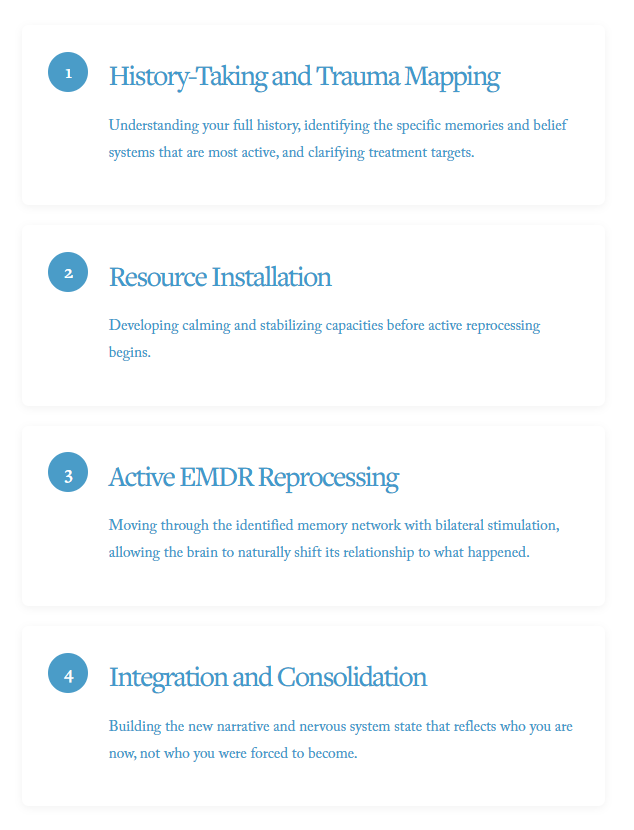
Trauma therapy is not a plunge into the deep end. The earliest sessions focus on assessment, psychoeducation, and building the internal resources that make deeper processing safe. That means emotional regulation skills, grounding practices, and nervous system awareness.Most people begin to notice meaningful shifts within 8 to 16 sessions for specific traumatic events, though complex or developmental trauma typically requires a longer arc. I offer flexible session scheduling and online therapy across California and Florida, making consistent care accessible regardless of where you are.Frequently Asked Questions About Trauma Therapy
-
No. One of the most meaningful aspects of EMDR is that it does not require you to verbally recount or narrate your traumatic experiences in detail. You hold the memory in mind internally while we work with it together. Many clients find this a significant relief.
-
This varies considerably depending on the nature and complexity of the trauma. Single-event PTSD may resolve meaningfully in 6 to 12 sessions. Complex or developmental trauma, the kind rooted in childhood or ongoing relational patterns, typically requires a longer course of treatment. We assess this together and adapt the plan as your healing progresses.
-
This is one of the most common concerns I hear. Trauma is not determined by the severity of an event. It is determined by the impact that event or pattern had on your nervous system. If you are struggling with symptoms that feel disproportionate, persistent, or confusing, trauma therapy may provide meaningful answers and relief.
-
Trauma is your body and brain's reactions to experiences. Trauma is traditionally thought of as an event that you have experienced or witnessed where you felt in danger. We have also come to understand that there are events we experience when we are young called developmental traumas. These are situations that happen when the people caring for us cannot meet our emotional needs. They can result in us not feeling cared for, feeling unsafe, unseen, or unheard. You might be experiencing feelings of depression, anxiety, or unease. You might have nightmares or flashbacks. You might avoid people, places, or situations. Trauma looks different in different people.
-
I work with clients who have experienced a wide range of trauma, including developmental trauma from childhood, one-time traumatic events such as accidents or medical diagnoses, grief and loss, and complex trauma resulting from ongoing difficult experiences. Whether your trauma feels "big" or "small," your experience is valid and deserving of care.
-
I use a combination of EMDR (Eye Movement Desensitization and Reprocessing), Polyvagal techniques, and Psychodynamic therapy. This integrated approach allows me to tailor treatment to your unique needs, addressing both the stored memories in your nervous system and the deeper patterns that developed as a result of your experiences.
-
EMDR is an evidence-based therapy that helps your brain reprocess traumatic memories so they no longer feel as distressing. During EMDR sessions, I guide you through recalling difficult memories while engaging in bilateral stimulation, which helps your brain process and integrate these experiences in a new way. Many clients find relief from symptoms that talk therapy alone did not fully resolve.
-
The length of trauma therapy varies depending on your unique history, goals, and how your mind and body respond to treatment. Some clients experience significant relief within a few months, while others with more complex trauma histories may benefit from longer-term work. I will collaborate with you to regularly assess your progress and adjust our approach as needed.
-
Yes, research supports that online therapy can be just as effective as in-person sessions for treating trauma. Many clients actually find that being in their own comfortable, private space helps them feel safer and more open during difficult work. I provide all my services through secure, confidential video sessions.
-
We begin with a free 20-minute consultation so I can learn about what brings you to therapy and you can ask any questions. After that, you will complete intake forms, and we will meet weekly. Early sessions focus on building trust, understanding your history, and developing coping skills to help you feel stable and resourced before we begin processing traumatic memories.
-
Yes. I have been very successful in doing EMDR online with many clients. The bilateral stimulation used in EMDR adapts effectively to virtual delivery through tapping, audio tones, or screen-based eye movement tools. Online therapy offers the additional benefit of receiving care in your own environment, which for many trauma survivors is actually more conducive to the nervous system regulation required for deep processing.
-
EMDR (Eye Movement Desensitization and Reprocessing) uses bilateral stimulation to help the brain reprocess traumatic memories, while TF-CBT (Trauma-Focused Cognitive Behavioral Therapy) uses structured cognitive and behavioral techniques to address trauma-related thoughts and behaviors. EMDR often requires less verbal narration of the traumatic event, which many clients find more comfortable. Both are evidence-based treatments endorsed by major health organizations.
-
Yes. Many of the women I work with carry what is often called developmental or relational trauma. It is the accumulated weight of being unseen, dismissed, criticized, or unsupported in ways that shaped the nervous system just as powerfully as more recognized traumatic events. You do not need a dramatic single event to benefit from trauma therapy. If the past is affecting the present in your emotions, your body, your relationships, or your sense of worth, that is the threshold.
Robyn Sheiniuk, LCSW is a licensed clinical social worker specializing in trauma therapy and EMDR for women in Culver City and throughout California. I offer a free 20-minute consultation to help you understand whether this approach is right for you and to answer any questions about the process.
Location: Culver City, CA
Online therapy available throughout California and Florida
Begin Trauma Therapy in Culver City

Restorative Counseling Center is a private practice led by Robyn Sheiniuk, LCSW, located in Culver City, CA, and providing online therapy to clients throughout California and Florida. The practice specializes in supporting women who are "high achievers" but are secretly struggling with the weight of trauma, grief, or a cancer diagnosis. Robyn utilizes evidence-based modalities, primarily Eye Movement Desensitization and Reprocessing (EMDR), to help clients process stuck memories and reduce emotional intensity, allowing them to move from a state of overwhelm to one of peace and insight.
If you are in crisis or experiencing a medical emergency, please call 911 or go to your nearest emergency room. You can also reach the 988 Suicide and Crisis Lifeline by calling or texting 988. This website does not provide crisis counseling or emergency services.